RQS Phase I
More than forty senior investigators and their teams participated in RQS Phase I from partner universities at the University of Maryland, Duke, Princeton, North Carolina State University, and Yale, with Harvard University joining through a supplemental project in 2025.
Research in RQS Phase I generated more than six hundred publications over the Institute’s first five years, and many new programs were created to ensure long-term community engagement for current members and alumni.
Research Focus
Quantum simulation Research Challenges (RCs) in Phase I (2021-2026), took a three-pronged approach to creating the scientific and engineering know-how needed to build real, reliable quantum simulators. Their experimental and theoretical work was broadly grouped into the following three RCs:
- RC1: Verified Quantum Simulations
- RC2: Quantum Simulations Face the Environment
- RC3: Scalable Quantum Simulations for Science and Technology
Research Partners
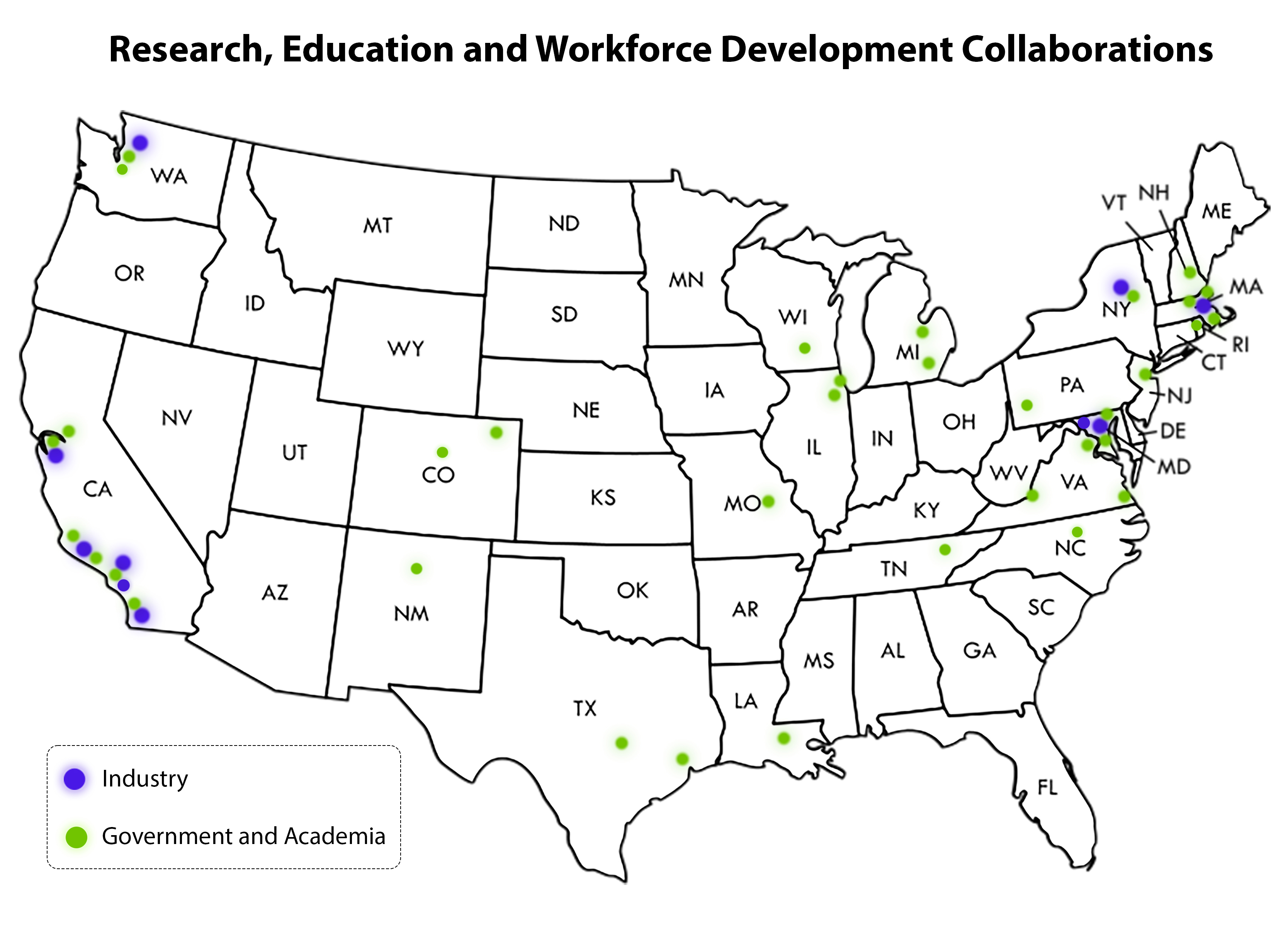
In Phase I, RQS partnered with industry, government, labs, and academia at a national level. These partners engaged with RQS on the interdisciplinary challenges of practical and verifiable quantum simulation. Working together and building on complementary strengths, the network helped identify new quantum applications, enable pre-competitive translation, and facilitated building a quantum-capable workforce.
RQS Phase I Programs
The Institute created more than a dozen programs to cultivate an environment of information sharing and collaboration across the RQS community and in the broader quantum industry. These programs focused on research dissemination as well as education, training, and job/internship placement. Many of these programs will continue to grow through RQS Phase II and in the broader community.
Research Programs
RQS Phase I delivered monthly research seminars to share latest findings and spark new ideas and collaborations. The annual institute workshop brought the RQS community together from our partner RQS universities to spend 2-3 days discussing the latest advancements through presentations and poster sessions. Many new collaborations formed through these events that resulted in new research publications and/or cross-disciplinary and cross-university seed grant teams that were funded by the RQS program for a one-year period of performance. RQS also provided travel funding to various conferences and schools, as well as exchange programs where teams from different universities were encouraged to co-locate and work on discrete projects together.
The Quantum Simulation conference (QSim) is an international annual conference on quantum simulation that aims to bridge theory and experiment, bringing together physicists, engineers, chemists, material scientists, mathematicians, and computer scientists working at the forefront of quantum simulation and related problems that include applications, algorithms, verification, noise, scaling, etc., for both analog and digital approaches. This conference stimulates interactions across disciplines and unveils new connections between seemingly disparate aspects of physics. QSim was started by RQS Phase I and hosted for three years by the Institute. This new flagship conference was then rolled out to the broader community and is being hosted on an annual basis by different organizations, while working under the guidance and charter as specified by an on-going strategic board. Learn more about QSim.
RQS postdoctoral researchers were actively engaged in all aspects of our collaboration to further their professional development and prepare them for successful independent careers through the Dual Mentorship program. To that end, RQS postdocs were offered two mentors, one for their research and another to provide advice on developing their skill sets and nurturing their careers. Regular meetings with assigned mentors were supplemented with other professional support in grant-writing, mentoring graduate and undergraduate students, and participation in research seminars.
Education, Training, Outreach, and Workforce Development
RQS Phase I made an early decision to bring about quantum awareness at all levels of the education spectrum, from K-12, undergraduate, graduate, and postdoc levels. As such, many programs started in Phase I will continue to grow and expand their footprint in Phase II. This includes the annual summer school and Quantum Leap Career Nexus (recruiting) programs targeted towards the undergraduate, graduate, and postdoc communities, as well as the quantum activity kits, teacher professional development targeted towards K-12 students and teachers, and demonstrations to the K-12 community. RQS also created undergraduate minors and master’s level programs to create new pathways into advanced quantum education.
RQS Phase I engaged in Oxford-style Mentoring at Morgan State University in Baltimore, where RQS faculty undertook an intensive, multi-year mentoring program with undergraduate students. Mentees benefit from student-led inquiry into topics in quantum physics, connections to mentors’ professional and academic networks, professional development, and lifelong relationships with their mentors.
In October 2025, the Quantum Education and Policy Summit brought together educators, industry leaders, and workforce-development experts from 27 states to the University of Maryland, the Capital of Quantum, to discuss a coordinated national strategy for training the future quantum workforce. Hosted by Q-SEnSE and the Chicago Quantum Exchange, with sponsorship from QED-C and RQS, the multi-day summit created opportunities for participants from community colleges, major research universities, and regional quantum ecosystems to align priorities and share challenges. Participants emphasized the importance of connecting the country’s rapidly growing but regionally distributed quantum initiatives, noting that collaborative planning is essential for building an effective national talent pipeline. Breakout sessions focused on regional priorities, institutional differences, and shared barriers, all contributing to a forthcoming report that will outline current needs and guide future quantum education efforts. The event resulted in a widely-circulated report about how to meet the demand of the growing quantum workforce. This conference was supported by NSF grant #2534943.
IYQ 2025
Quantum for All at the University of Maryland
We celebrated World Quantum Day with the University of Maryland at this special event, featuring a fireside chat with Nobel Laureate William D. Phillips and a quantum community showcase. Read more.
Teacher Professional Development Workshops: Bring Quantum to Your Classroom! (April 12, 2025 at Morgan State University & April 19, 2025 at University of Maryland)
Using the RQS quantum activity kits and other curricular materials, over 30 local middle and high school teachers from eight different Maryland and DC public school districts learned how to implement quantum concepts in their physics, computer science, or engineering classrooms. Co-hosted with the Morgan State University Department of Physics, the plans and research findings from these workshops were shared with the wider quantum education community as an invited talk at the 2025 AAPT Summer Meeting.
Quantum & Public Policy Panel Discussion (April 17, 2025 at UMD and Online)
Through a series of short talks and a panel discussion on career pathways for scientists interested in public policy, this event introduced graduate and undergraduate students, postdocs, and early-career scientists to the landscape of organizations, programs, and policies that will guide and shape their own careers. This panel featured representatives from organizations across the quantum policy landscape, offering multiple perspectives on this exciting field.